

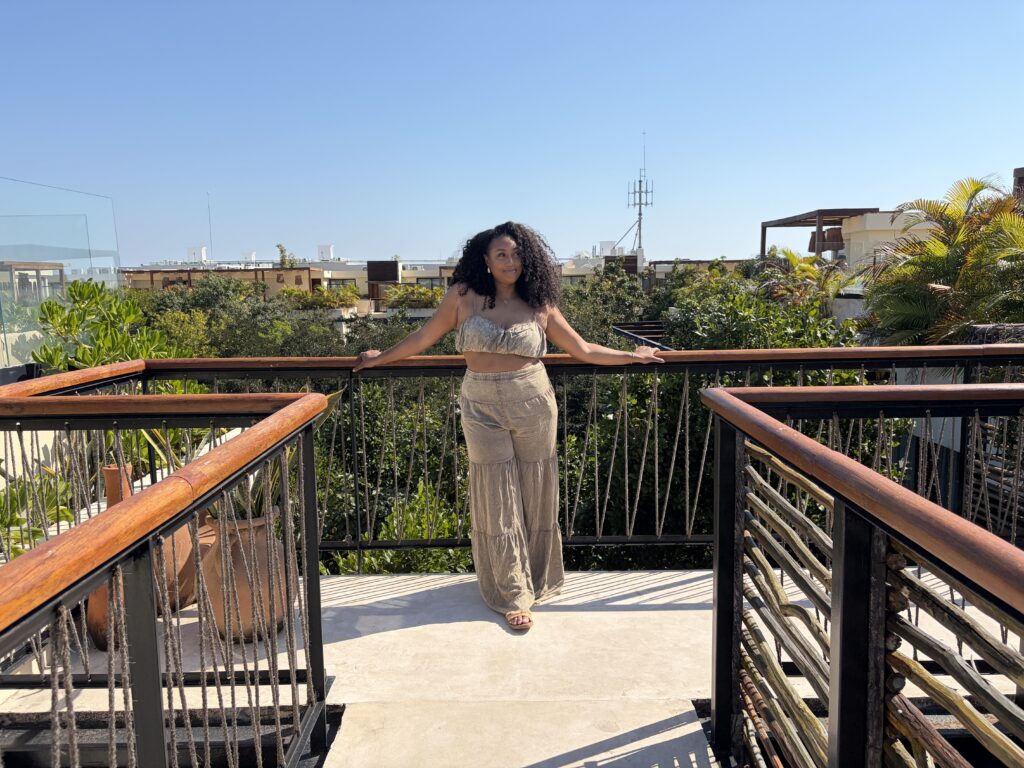


Before You Go
A few things worth knowing before you land in Tulum, Mexico — so you can skip the rookie mistakes and get straight to the good part.
Who This Trip Is For
Tulum is perfect for couples and groups looking for a Tulum couples trip or a girls trip with a vibe. I personally wouldn’t travel here solo — this destination is just better shared. If you’re planning a romantic getaway, anniversary trip, or a Tulum girls trip, you’re in the right place.
The Water Will Get You
I’m not playing with you on this one. Do not brush your teeth with the tap water in Tulum. I learned this the hard way my first night — I was sick before the trip even really started. Stick to bottled water for everything, including brushing your teeth. Most hotels will have bottled water available, so use it.
Cash or Card — Both Work
You can use either, but cash goes a long way in Tulum. The local currency is pesos, and your USD stretches further than you’d expect when traveling to Tulum from the US. I’d recommend having a mix of both — card for hotels and larger restaurants, cash for local spots, markets, and tips.
What to Expect
Tulum has the perfect amount of everything. It’s relaxed enough that a lazy beach day feels like pure paradise, but there’s always something to do when you’re ready to move. It also sits right in the middle of some of the best spots on the Riviera Maya — Playa del Carmen and Cancún are both close, so day trips from Tulum are easy when you’re ready to explore beyond the town.
When to Go — Best Months + Price Windows
I’ve been to Tulum in May, February, and November — and honestly, all three were great for different reasons. Here’s how to pick the right time for your trip.
November — The Sweet Spot
Temperatures sit around a comfortable 27–28°C (80–82°F) with low humidity and barely any rain. November gives you dry season weather, minimal seaweed, pre-holiday prices, and manageable crowds. The beaches are clean, the cenotes are gorgeous, and you’re not fighting tourists for a beach club chair. Hotels are also cheaper than peak season — which means more money for experiences.
February — Best Weather of the Year
Expect daytime highs of 78–83°F (26–28°C) with evening cooling to around 68–73°F (20–23°C). It’s peak season so expect higher prices and more tourists — but if perfect weather is your priority, February delivers every time. Just know Valentine’s week gets pricey at couples-focused resorts.
May — Great Value, Fewer Crowds
This is when I took my trip and I loved it. May averages around 33°C (91°F) — warm and sunny with mornings almost always clear. Prices drop significantly compared to peak season and the vibe is more relaxed with fewer tourists. You may get occasional afternoon showers but they usually clear by dinner.
Summer (June–August) — Go for the Nightlife
If beach clubs, DJ sets, and a full social scene are what you’re after, summer is your season. The energy is completely different — louder, more people, more nightlife. Just know it’s also the hottest, most humid time of year with temps pushing 90–95°F (32–35°C), and seaweed on the beaches can be an issue.
Avoid September–October
These are the emptiest months but come with hurricane risk and heavy sargassum. The deals are real but so is the risk of a ruined trip. Not worth it for most travelers.
One Thing Nobody Tells You About — Sargassum
Sargassum is brown seaweed that washes up on Caribbean beaches and it can be bad in Tulum. For the cleanest beaches, visit November through March when seaweed is minimal. If you go in summer, have a backup plan — the cenotes are always beautiful regardless of what the beach looks like.

Getting There — Flights + Airports
You’ll fly into Cancún — here’s everything you need to know from the moment you land to the moment you pull up to your hotel.
The Airport — Heads Up
Cancún International Airport (CUN) is the main gateway for Tulum trips and it is busy. When you get off the plane, you will have a lot of people approaching you trying to sell you transportation, tours, and all kinds of things. Stay calm, keep walking, and don’t stop to talk to anyone until you’re at your rental car counter. You can also just say “no gracias” and they’ll chill out. I’ve flown in on Southwest and JetBlue with no issues on either — both get you into CUN without drama.
Renting a Car — Book Enterprise in Advance
This is my biggest tip for getting to Tulum: rent your car ahead of time and book directly with Enterprise. When I arrived, my name was already at the counter — no waiting, no negotiating, no stress. They shuttle you from the airport to their lot in an air-conditioned van and the whole team was friendly and professional. Booking in advance makes all the difference.
One thing to know — avoid driving after 9 PM. Low light and animal crossings on Highway 307 make night driving risky. Plan your arrival so you’re pulling into Tulum before dark.
The Drive
From CUN to Tulum it’s about 73 miles (118 km) — roughly 1.5 hours under normal traffic conditions. You’ll take Highway 307 the whole way — it’s a straight, well-paved road and easy to navigate. If you pass the Playa del Carmen overpass after 10:30 AM, expect a 20-minute bottleneck — so try to time your drive accordingly. Download your maps offline before you go since cell service can get spotty on parts of the route.
If You Don’t Want to Drive
No problem. A private transfer from CUN to Tulum runs about $90–$159 USD one way and includes door-to-door service with a bilingual driver who monitors your flight. It’s the easiest option if you’d rather not deal with driving in a new country.
Getting Around — Car Rental, Taxis + Colectivos
Tulum is very drivable — and having your own car makes the whole trip easier and cheaper. Here’s what you need to know.
Rent a Car — It’s Worth It
I always rent a car in Tulum and I recommend you do the same. When I went as a couple we got a standard car, and when I went with friends we upgraded to an SUV — both worked perfectly. Having your own car means you’re not waiting on taxis or splitting ride costs every time you want to go somewhere. Over 4 nights it saves you real money and gives you the freedom to move on your own schedule.
Book with Enterprise in advance. You can pick up your car right at the CUN airport — they shuttle you from arrivals to their lot in an air-conditioned van and everything is ready when you get there. No haggling, no surprises.
Parking
Parking in Tulum is easy. Every beach club, restaurant, and hotel we went to had a designated lot and it was never a problem finding a spot. Most places also had card readers so you don’t need to stress about having exact cash on hand for parking.
Watch the Roads
This is important — the roads near Tulum can get bumpy, especially as you get closer to the hotel zone and beach area. Take it slow on uneven stretches so you don’t end up with a flat tire. You’ll also hit speed bumps called topes throughout the area — they come up fast and can do real damage to a rental car if you don’t slow down for them. Just stay alert and you’ll be fine.
A Few Extra Tips
- Download Google Maps offline before you leave — cell service gets spotty in parts of Tulum
- Fill up on gas before heading into the beach zone — stations get sparse the further south you go
- Avoid driving after dark — road lighting is minimal and animals cross the highway at night
Where to Stay
Stay in Canmore — you get more space, better value, and mountain views that rival anything in Banff town.
There is only one hotel I recommend in Tulum — and I will stand on that.
Copal Tulum Hotel — $82/night
Copal is nestled in the Aldea Zama district, one of Tulum’s most exclusive residential enclaves — a jungle sanctuary that’s still just a 10-minute drive from the beach zone and town center. It is the perfect middle ground between nature and convenience.
The moment you check in, they walk you through the entire property so you know exactly where everything is. That alone tells you the kind of service you’re getting. From there, you’re added to a WhatsApp group chat where the team is available to help you with anything you need — restaurant recommendations, excursion bookings, whatever comes up. It genuinely feels like family.
The hotel sits on 6,000 square meters of jungle so when I say it feels like you’re surrounded by nature, I mean it literally. The walkways wind through the trees, the pool is at jungle level, and the whole vibe is peaceful and lush. But it never feels rough or rustic — the rooms are clean, comfortable, and modern with AC, WiFi, and flat screen TVs.
What’s included:
- Continental breakfast every morning Travelocity
- Two on-site restaurants — you can also order room service
- Rooftop pool, spa, fitness center, and yoga studio KAYAK
- Security at the entrance and roaming the property around the clock — I always felt completely safe
- Free parking on site
- A spa that is actually worth it — I got a pedicure and it was one of the highlights of my trip
Copal also has two restaurants on site — Copal Gastro Bar, which serves international cuisine with a Mexican soul, and Kokoro, an intimate rooftop spot with Japanese-inspired dishes and handcrafted cocktails.
At $82/night for a 5-star boutique hotel in the Tulum jungle, this is one of the best values I’ve found anywhere I’ve traveled. Book directly on their website and reach out to them in advance — they are incredibly responsive.
Where to Eat
If you like seafood and pizza , you’re going to like Banff and Canmore. They both have excellent food scenes.
Fine Dining
Sky Bistro at the Banff Gondola — Sulphur Mountain
One of the most unforgettable dining experiences I’ve ever had. You take the gondola up Sulphur Mountain and dine at the top with floor-to-ceiling windows looking out over the entire Banff valley. Sky Bistro serves contemporary Canadian cuisine with locally sourced ingredients — the kind of meal that tastes even better because of where you’re eating it.
We did Ryan’s birthday dinner here and pre-arranged a dessert, some bubbly, and a candle. Request a west-facing window table for the best sunset views — in June the sun doesn’t set until around 10pm so the light through those windows is stunning. Book well in advance at banffgondola.com. The Buccaneer ResortMarriott Bonvoy
The Bison Restaurant — Banff Town
Rustic mountain fine dining featuring Alberta-raised bison, elk, and locally sourced Canadian ingredients in a warm, lodge-style dining room. One of the most celebrated restaurants in Banff for a reason. Great for a first-night dinner after the drive in. Reservations strongly recommended. GoToStCroix
Casual + Local
Park Distillery — Banff Avenue
A restaurant and craft distillery right on Banff Avenue serving campfire-inspired food alongside house-made spirits. Great for lunch or a casual patio dinner. The patio is one of the best spots in Banff on a warm evening. Order the wood-fired dishes and try one of their signature cocktails made with Alberta-grown grain spirits. The Buccaneer Resort
Three Ravens Restaurant at Banff Centre — Tunnel Mountain
Panoramic views of the Bow Valley with a seasonal, farm-to-table menu rooted in Canadian ingredients. More relaxed than Sky Bistro but with equally stunning views. Great alternative for a second special dinner. Wikipedia
Seafood — Do Not Skip This
Banff and Canmore have surprisingly excellent seafood — the oysters and fish are exceptional. Ask your hotel for their current recommendation for the best seafood spot during your stay. Alberta is landlocked but the seafood quality is genuinely impressive.
Canmore Town Center
The Canmore town center right near Golden Ridge has its own collection of restaurants, cafes, and shops. Great for a quick breakfast, coffee, or low-key dinner without driving into Banff. Walk around and explore — there are some real gems.
What to Do
Three days in Banff is enough to hit the highlights — here’s everything worth your time.
The Lakes — Non-Negotiable
Lake Louise — Banff National Park
This is my #1 thing we did! Lake Louise is one of Canada’s most iconic natural landmarks — a glacial lake with turquoise water framed by Victoria Glacier and surrounded by mountain peaks. The late afternoon light on the lake is absolutely gorgeous for photos. Rent a canoe at the Fairmont Chateau Lake Louise Boathouse for the most magical hour you’ll spend in Canada — $145 CAD/hour and worth every penny. Being out on that water with the mountains and glacier surrounding you is something you will never forget.
Moraine Lake — Valley of the Ten Peaks
Moraine Lake is widely considered one of the most photographed lakes in the world — a stunning turquoise glacial lake surrounded by ten mountain peaks. The Rockpile viewpoint at the far end of the lake gives you the iconic postcard shot. Walk the lakeshore trail for different angles and get there as early as possible — the morning light on the water is incredible. Remember: you must book the Parks Canada shuttle in advance at reservation.pc.gc.ca — private vehicles are not allowed on Moraine Lake Road in peak season.
Scenic Drives + Views
Vermilion Lakes Drive
A short scenic loop just outside Banff town with stunning views of Mount Rundle and the surrounding peaks reflected in the lakes. Multiple photo stops along the way — perfect for a slow morning drive before lunch. One of those places that looks unreal even through a phone camera.
Banff Gondola + Sulphur Mountain
The Banff Gondola takes you 2,281 meters above sea level to the summit of Sulphur Mountain in just 8 minutes, with 360-degree views of six mountain ranges. Go at sunset or in the evening for the most dramatic light. Book your gondola ticket and Sky Bistro reservation together at banffgondola.com.
The gondola runs late enough in summer to catch the late evening light — in June that means views well past 9pm.
Icefields Parkway (If You Have Extra Time)
The Icefields Parkway stretches 232 km from Lake Louise to Jasper and is consistently ranked one of the most scenic drives in the world — passing glaciers, turquoise lakes, and mountain peaks the entire way. It’s a longer commitment than a 3-night trip easily allows but if you have an extra half day, even driving an hour up the parkway and back is worth it.
Water Activities
Canoe on Bow River — Banff Canoe Club
The Banff Canoe Club rents canoes on the Bow River right in the heart of Banff town — a calm, scenic paddle through the valley with mountain views on every side. $50 CAD/hour. One of the most romantic and peaceful things you can do on this trip. Just you, the river, and mountains as far as you can see. No experience needed.
Lake Louise Canoeing
Already covered above — rent from the Fairmont boathouse at $145 CAD/hour. Non-negotiable experience on this trip. That’s where you’re going to get those super cute photos.
Relaxation
Banff Upper Hot Springs — Sulphur Mountain
Natural hot springs perched on the side of Sulphur Mountain with views of the surrounding peaks — the highest commercially operated hot springs in Canada. Perfect after a day of hiking or canoeing. Admission runs about $18–$20 CAD per adult and includes a towel rental. Go in the late afternoon or early evening when the light hits the mountains beautifully. TrivagoTrivago
Golden Ridge Rooftop Hot Tub
Do not underestimate this. Soaking in the hot tub on the roof of Golden Ridge with the Rockies surrounding you on all sides — especially in the evening — is one of the most memorable moments of the entire trip. The rooftop hot tub is open daily 9am–10pm with a cleaning break from 12pm–1pm.
History + Culture
Banff Avenue
The main street of Banff town is lined with shops, restaurants, and galleries set against a stunning mountain backdrop. Worth a stroll in the evening after dinner — the town is charming and walkable. Pick up some Canadian maple syrup, local souvenirs, and ice cream on the way back to your car. Booking.com
What to Pack
Banff requires a specific packing list — the weather changes fast in the mountains.
Documents + Money
- Passport — valid for at least 6 months beyond your travel dates
- Credit card — widely accepted everywhere in Canada
- Some Canadian cash for small purchases and tips
- Parks Canada Discovery Pass — buy online before you go at pc.gc.ca
Layers Are Everything
Mountain weather is unpredictable even in summer. June days can be warm and sunny but evenings cool down quickly — especially at elevation. Pack:
- A good waterproof rain jacket — non-negotiable
- Light fleece or mid-layer for evenings
- T-shirts and light layers for warm daytime hours
- One nicer outfit for Sky Bistro and The Bison
- Comfortable walking shoes with good grip for lakeside trails
- Hiking boots or trail shoes if you plan to hike
Outdoor Essentials
- Sunscreen — the UV at altitude is stronger than you expect
- Reusable water bottle — stay hydrated, especially at elevation
- Bug spray — mosquitoes are present near the lakes in summer
- Portable phone charger — you will be taking photos constantly and battery drains fast
For the Water
- Swimsuit — for the hot springs and Golden Ridge hot tub
- Quick-dry towel
- Light waterproof layer for canoeing
What to Leave Home
- High heels — the terrain is uneven everywhere
- Heavy luggage — you’ll be moving between the car and trails regularly
- Chemical sunscreen near the lakes — be mindful of the fragile glacial lake ecosystems

